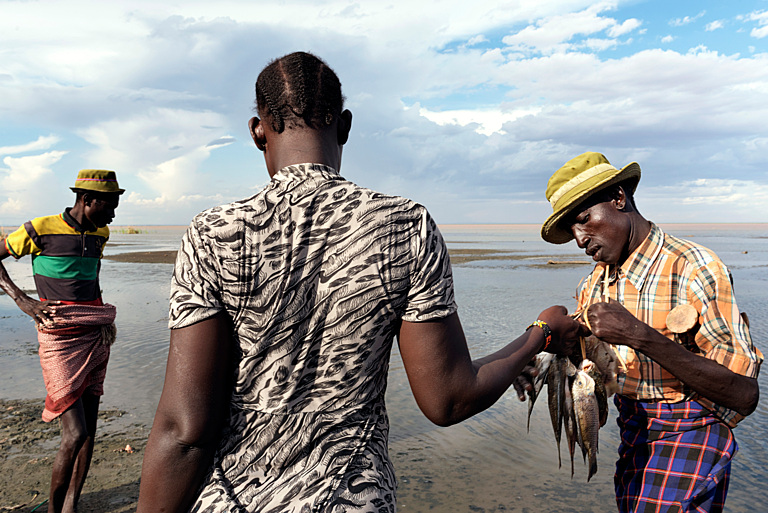
People fishing in Lake Turkana in Ethiopia, where increasing air temperature and frequent and prolonged droughts have reduced the natural resource base. Image: Maurizio Di Pietro / Climate Visuals
One group of people who should be at the centre of all climate stories, but who are often absent, are those directly affected by climate change.
These could be farmers affected by severe droughts, residents forced to move due to hurricanes or floods, coastal residents affected by the rise of sea level, or fishermen struggling to find fish as warming waters and coral bleaching reduce fish stocks.
They might be workers who are losing their jobs as a result of the transition to less polluting technologies.
Or they could be elderly or vulnerable people who suffer worsening health in increased temperatures, but who can’t afford to make their homes cooler.
Climate change is having severe impacts on people, and action on climate change also has impacts which are often unequal. As journalists, we need to hear from those affected and give them a chance to be engaged in discussions about the future.
You don’t need to become a climate scientist yourself in order to report correctly on climate change, but you do need to be able to identify sources of reliable information.
The definitive starting point is the Intergovernmental Panel on Climate Change, the IPCC, which is a UN body bringing together the world’s leading climate experts. The IPCC website contains a wealth of information, including data broken down by country and industry.
You will find climate scientists working in your local university, probably in the geography or Earth sciences department.
The Science Media Centre is an independent press office providing briefings on the latest scientific papers and can help find scientific experts/voices.
If you struggle to understand scientists, connect with reporters in specialist journals and publications who can bridge the gap.
“The job of the scientist is to find results, show relationships, find patterns, and search for truth and information. It is the job of the journalist to tell stories and to make information human. Journalists and scientists can team up to show people how scientific findings impact their lives.”
The UK Meteorological Office has a well developed climate programme and is skilled at public communication. In other countries, look for your national weather forecasting agency.
The EU’s Copernicus climate programme gathers information about the state of the Earth from satellites and other sources, making its data freely available.
Government
A good place to start looking for official sources is your country’s NDC, or climate action plan. As well as outlining your government’s approach to action on climate change, typically they include a list of the departments, agencies and academic and science bodies that are active in the field and have contributed to the action plan. The UN’s Climate Change secretariat maintains an index of NDC’s here: https://unfccc.int/NDCREG
Every country’s government is organised differently, but you might look for civil servants and experts working on climate change in these sorts of departments and ministries:
Environment
Economy/Finance
Business, Energy and Industry
Labour and Social Policy
Agriculture, Forestry and Water Supply
Transport
Education and Science
Statistical Office
Local government, regions and mayors – these are often tasked with making changes at a local level, such as providing public transport, active travel options, and planting trees in cities.
The UN Framework Convention on Climate Change (UNFCCC), which often brands itself as UN Climate Change, is how countries collaborate to reduce emissions. Look here for the latest on global negotiations. UNFCCC manages the climate COPs, so look here for information about the next COP and how to register for press releases and/or to attend. Each COP also has its own website – for example, COP30 in Belém, Brazil is at https://cop30.br/ – and you should also monitor this site for news about the summit.
The World Bank is especially focussed on finding the finance for less wealthy nations to manage the transition to low-carbon economies. Its Climate Change Knowledge Portal provides access to global, regional, and country data related to climate change and development.
The UN High Commissioner for Refugees (UNHCR) provides protection and assistance to many refugees and internally displaced people impacted by the climate emergency as well as helping them increase their resilience in a changing climate.
European Environment Agency is an excellent source of data for the continent, member states and cooperating countries.
Non-governmental organisations
Industries and businesses and their associations (Chambers of Commerce).
Unions representing workers in other affected industries.
Local, national or multinational NGOs related to environment and human rights issues. There are climate specialists in many large membership and advocacy organisations such as the Worldwide Fund for Nature (WWF), the International Union for Conservation of Nature, and Greenpeace. In your country, look for conservation, wildlife, heritage and outdoor groups.
Specialist journalists and publications
Keeping an eye on what other news outlets are publishing on climate change will help you keep abreast of latest developments. You should certainly follow a relevant selection on your social media feeds.
During the COP summits, Bloomberg‘s specialist news is free of charge to access and they provide a daily newsletter on the negotiations.
Specialist publications are very helpful in bridging the gap between the complex science and policy issues and those of us who lack that degree of specialisation.
Carbon Brief is a UK-based website covering the latest developments in climate science, climate policy and energy policy. It is run by a former journalist and provides really helpful briefings for journalists trying to understand complex aspects of climate science and policy. Much of the information is free to re-use, subject to a credit.
The Energy & Climate Intelligence Unitis a research NGO which provides really helpful briefings for journalists trying to understand complex aspects of climate science and policy.
Climate Home News performs a similar role with a more international focus.
Covering Climate Now is an exceptionally rich resource for journalists reporting on climate change, with a wealth of resources including recorded discussions and factsheets. There is a programme of webinars that are open to all journalists around the world, free of charge.
The Climate Reporting Toolkit Africa provides practical, actionable information for African journalists to help improve their reporting of climate change topics, with a specific focus on amplifying African expertise in climate and related fields.
Exercise
You probably already have a list of reliable contacts you can go to for information and advice on climate change. If not, start one!
Identify 10 new sources to add to your list. Reach out to organisations and identify the right people to speak to. Introduce yourself and explain your interest. Ask them what they’re doing — it doesn’t have to be newsworthy, you’re after background information and a better understanding. But perhaps they’ll tell you something you can use in a story! Ask them who else they think you should speak to. Follow the chain and build up your contacts database!


 Reporting Climate Change: tips from the IFJ