

Although scientists had been warning of the danger of fossil fuels and other human activity causing a warming of the planet for many decades, it wasn’t until the 1980s that governments of the world really began to accept the reality of global climate change.
The first time the United Nations held a conference to talk about humans and the environment was in 1972, when more than 100 heads of state met in Stockholm to discuss environmental issues.
In 1992 the United Nations Earth Summit in Rio de Janeiro, known as Eco 92 or Rio 92, set out plans to tackle the linked scourges of climate change, desertification and biodiversity loss – in other words, the loss of habitats and species due to development, pollution, hunting and, indeed, climate change.
Three major treaties, known as conventions, were agreed:
- The United Nations Framework Convention on Climate Change (UNFCCC);
- The UN Convention on Biological Diversity (CBD);
- The UN Convention to Combat Desertification (UNCCD).
Every year since, signatories to these conventions have met to discuss progress. These meetings are called COPs, or Conferences of the Parties – ie, meetings of the signatories.
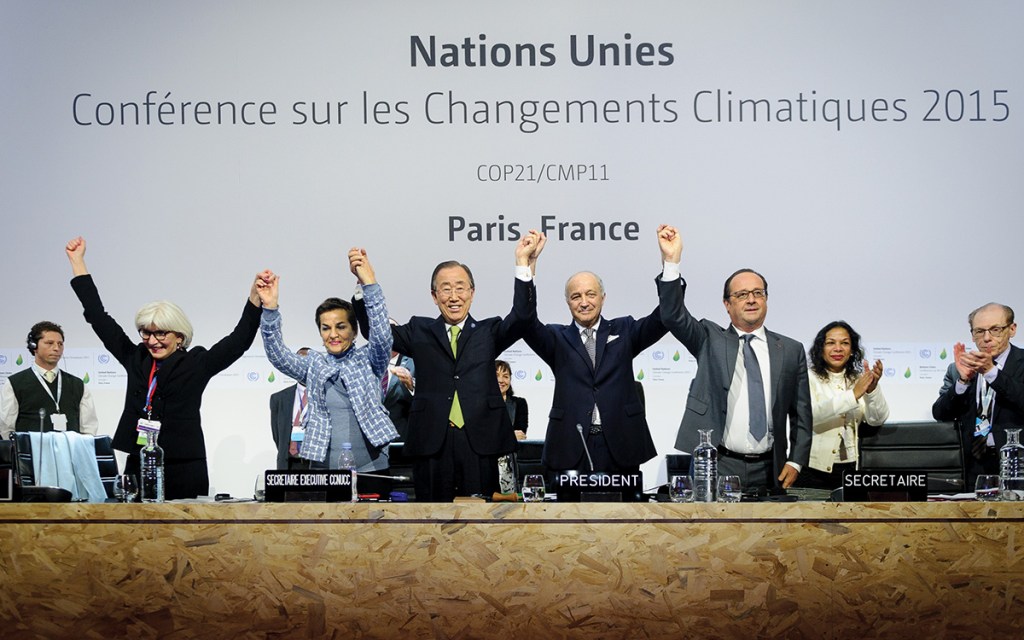
The most significant breakthrough in global action on climate came at COP21 in Paris in 2015, where almost 200 countries promised to set themselves challenging targets to reduce greenhouse gas emissions.
This UN video explains what they agreed:
The next climate COP, COP30, will take place in Belém in Brazil.
WHAT IS THE PARIS AGREEMENT?
The Paris Agreement is a legally binding international treaty on climate change which has been signed by more than 195 countries.
It aims to:
- Keep global temperatures well below 2 ºC above pre-industrial times and “endeavour to limit” them even more to 1.5 ºC.
- Limit the amount of greenhouse gases emitted by human activity to the same levels that can be absorbed back, either naturally through trees, soil and oceans or through technology, (ie, reach Net Zero), beginning at some point between 2050 and 2100.
- Review each country’s contribution to cutting emissions every five years so they scale up to the challenge. These plans are called Nationally Determined Contributions (NDCs) and are available to the public once they are submitted.
- Ensure rich countries help poorer nations by providing “climate finance” to adapt to climate change and reduce their greenhouse gas emissions.
The point of the 1.5 degree target is that scientists believe that our planet might slide into a state of “runaway” or uncontrollable climate change beyond that temperature rise.
But even at this threshold, the level of warming would not be without costs or consequences. As the IPCC said,
“Keeping to the preferred target of 1.5 ºC above pre-industrial levels will mean rapid, far-reaching and unprecedented changes in all aspects of society.”
Even if the world manages to limit warming to 1.5 degrees, we will endure even more serious impacts than we experience now.
According to the IPCC, we must reach net zero by 2050 to be able to limit the warming to 1.5 ºC, but the current policies presently in place around the world are projected to result in about 2.7 °C warming above pre-industrial levels.
So what’s the plan?
Two key terms you need to know are adaptation and mitigation, key themes when it comes to climate finance under the Paris Agreement.
Two of the IPCC’s most recent reports focus on these themes.
Adaptation
Adaptation is the term scientists use to describe the changes we need to make to manage to live with the consequences of a changing climate, such as:
- Building flood defences along coasts and riverbanks.
- Fitting air conditioning to homes in normally cool climates which are becoming warmer.
- Changing the crops we grow to suit weather conditions.
- Learning to treat unfamiliar diseases and conditions.
- Turning coastal cities into ‘sponge cities’ as a way to prevent floods.
The cost of adapting to a changed climate will, of course, be much more severe for people in the worst-affected areas, who are likely to be among the world’s poorest and therefore least able to adapt to a changing environment.
For this reason many poorer nations are seeking funding from the wealthiest nations (which have, over time, contributed most to the build-up of carbon in the atmosphere) to pay for the costs of adaptation.
Mitigation
Mitigation is about trying to reduce the causes of the problem, by reducing the release of greenhouse gases into the atmosphere, or removing the gases that are already there.
“The less we mitigate, the more we have to adapt. So, investing in mitigation is a way of reducing the need to invest on adaptation and resilience.”
Simon Stiell, UN Climate Change Executive Secretary.
The most urgent and challenging requirement is to completely stop using fossil fuels such as coal, oil and gas, over the next two or three decades, and move to generating energy using renewable sources such as solar, wind, and hydro power. Some argue that nuclear power – which is costly and has considerable challenges in operating safely and disposing of nuclear waste, but which does not emit carbon to a comparable extent as fossil fuels – should have a role to play.
At COP28 in Dubai – itself a major oil producing nation – countries explicitly agreed for the first time to move away from fossil fuels and towards renewable energy, but they missed out on creating specific goals on numbers and dates.
Significant changes will be required in other industries which release large volumes of greenhouse gases, including:
- Agriculture
- Livestock
- Transport
- Shipping
- Aviation
- Waste management
- Construction
- Steel-making
Individuals, especially from wealthier countries, have the opportunity to make the most significant changes, but every single person should make changes to lower their carbon footprint, with actions like:
- Flying much less, both for work and leisure.
- Swapping their petrol or diesel vehicles for electric-powered ones or, better still, public transport, or swapping their fuel for biofuels.
- Installing heating and cooling systems which don’t depend on fossil fuels.
- Changing their diet to include more vegetables and reduce their consumption of meat and dairy.
- Consuming only what is necessary; composting organic residues, producing less trash.
Climate scientists recognise that it will not be possible to prevent all emissions of carbon. In order to reach net zero – where carbon emissions are balanced with removal of a similar amount of carbon from the atmosphere – natural and advanced technologies will be required.
These may include:
- Land based methods such as protecting and restoring forests, peatlands, coastal wetlands, savannahs and grasslands.
- Agricultural methods of carbon removal include soil carbon management and improved livestock rearing.
- Chemical and geoengineering methods of carbon capture and storage (CCS) such as using machines to suck CO2 from the air and lock it safely away, for example in former oil and gas wells. Some place a lot of hope in this technology, but it is problematic as it itself uses a lot of energy and the technology is expensive. Currently only 0.1% of emissions are successfully captured this way.
- Bioenergy with carbon capture and storage (BECCS) involves growing crops, burning them to generate energy and capturing the released CO2.
- Reduce as much as possible the sending of solid waste to landfills and dumps, diverting it for recycling, reuse and composting.
Besides adaptation and mitigation, you will also hear the term loss and damage, which refers to those impacts caused by climate change that cannot be mitigated or for which it is impossible to prepare.
COP28 in Dubai officially approved the Loss and Damage Fund, accessible to any developing country independently of their size or economy, with priority for more vulnerable countries.
Measuring progress
All the countries that have signed the Paris Agreement are obliged to submit a report on its progress to Net Zero every five years in a document called Nationally Determined Contributions [to Net Zero], or NDC for short. The name indicates that countries commit to an international pledge to reach Net Zero by 2050, but how they do so is up to them.
The NDCs are a good starting point for journalists trying to understand a country’s plans.
A formal process called the Global Stocktake assesses each country’s plans. The 2024 assessment said the findings were “stark but not surprising”.
Reflection: What is your country doing to reduce its greenhouse gas emissions?
Where does your country stand on the table of emitters? How much has it contributed to global climate change?
What mitigation measures are in place already, and what are proposed?
Look up your country’s NDC to see what it has pledged internationally.
Do the promises match reality?
How well is the public informed about the pledges?
Do they accept the need for action on climate change?
 Reporting Climate Change: tips from the IFJ